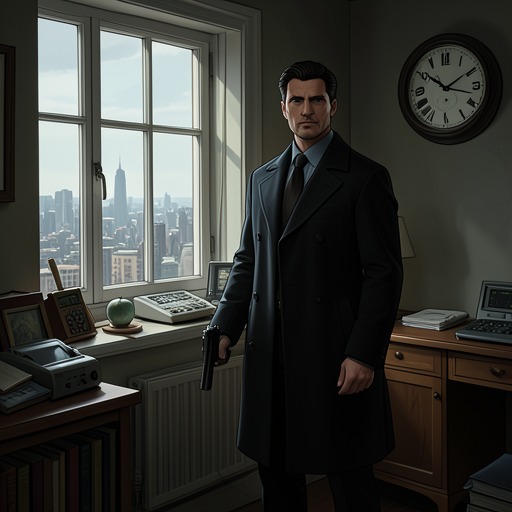
Amos Crane murders David Keller and assumes his identity
Down Cemetery RoadAmos Crane murders David Keller and assumes his identity in a calculated act presented with chillingly little reflection: Keller’s face, name, and car become resources Crane can take once their owner is dead. The killing gives Crane a temporary identity, but its delayed revelation also turns a familiar face into a warning for Sarah and Zoë.
The Murder and Its Purpose
Keller’s death begins with an apparently ordinary encounter. He has given Amos Crane a lift; later, at a roadstop, he drinks what the narration identifies as his final cup of coffee. Amos kills him there. Keller’s only fault, in the grim logic applied to him, is that he was useful: Amos needed a temporary identity, and Keller’s would serve.
The narration extends that logic from identity to property. Amos needs a car, and the dead Keller can no longer use his. The sequence is brutally practical: a man who offered help is killed, then reduced to the name and vehicle his killer can appropriate. Sarah and Zoë, who later need a lift, find that Keller is no longer alive to give one.
The Logic of Necessity
The account stresses not a complicated motive but the absence of moral hesitation. Amos gives Keller’s death no more thought or regret than the matter of pharmaceuticals that opens the passage. He treats the killing as something already settled—as necessary, or at least desirable, or simply about to happen. In that reasoning, inevitability stands in for justification: what is about to happen, the narration observes, cannot be argued with.
That language makes the murder more than a disguise-changing maneuver. Amos’s ability to use another person’s life as a temporary solution depends on refusing to recognize Keller as anything beyond the obstacle and opportunity in front of him. The plainness of the exchange—the lift, the coffee, the car—sharpens the violence: no grand confrontation is required for Keller to disappear and his ordinary life to become an asset for his killer.
Keller’s Face as a Delayed Clue
The murder is disclosed when Dinah points toward the man she recognizes, and Sarah and Zoë turn to look at David Keller. The narration immediately overturns that identification: Keller is dead, lying some miles away near the roadstop where he drank his final coffee. The figure they see is not Keller but Amos Crane, looking back at them through the identity he has stolen.
The interval between those two facts makes the face itself a clue. What first appears to be Keller’s return is evidence that someone has taken his place. The revelation links the earlier roadside killing to the present danger without making the violence visible when it occurred: the dead man remains elsewhere while his murderer occupies his name and likeness.
The Killing’s Consequences
At the later encounter, Amos comes forward and crouches near Sarah and Zoë in the empty space built for worship. His kind smile brings Sarah back to the earlier image of Rufus—then uncertainly identified as Axel—leering at her in her kitchen before trying to kill her. The connection makes Amos’s disguise part of a repeated threat: the apparent identity changes, but Sarah recognizes the danger underneath it.
Sarah understands the scene as a return to its beginning, thinking that all the distance traveled has brought them back to the same end. Zoë reaches for her gun, but Amos already has it in his hand. Keller’s stolen identity has carried Amos into this confrontation, where recognition arrives too late to prevent him from taking control of the weapon. The murder’s consequence is therefore both practical and dramatic: it lets Amos pass as another man, then brings the violence concealed by that borrowed identity directly before Sarah and Zoë.